

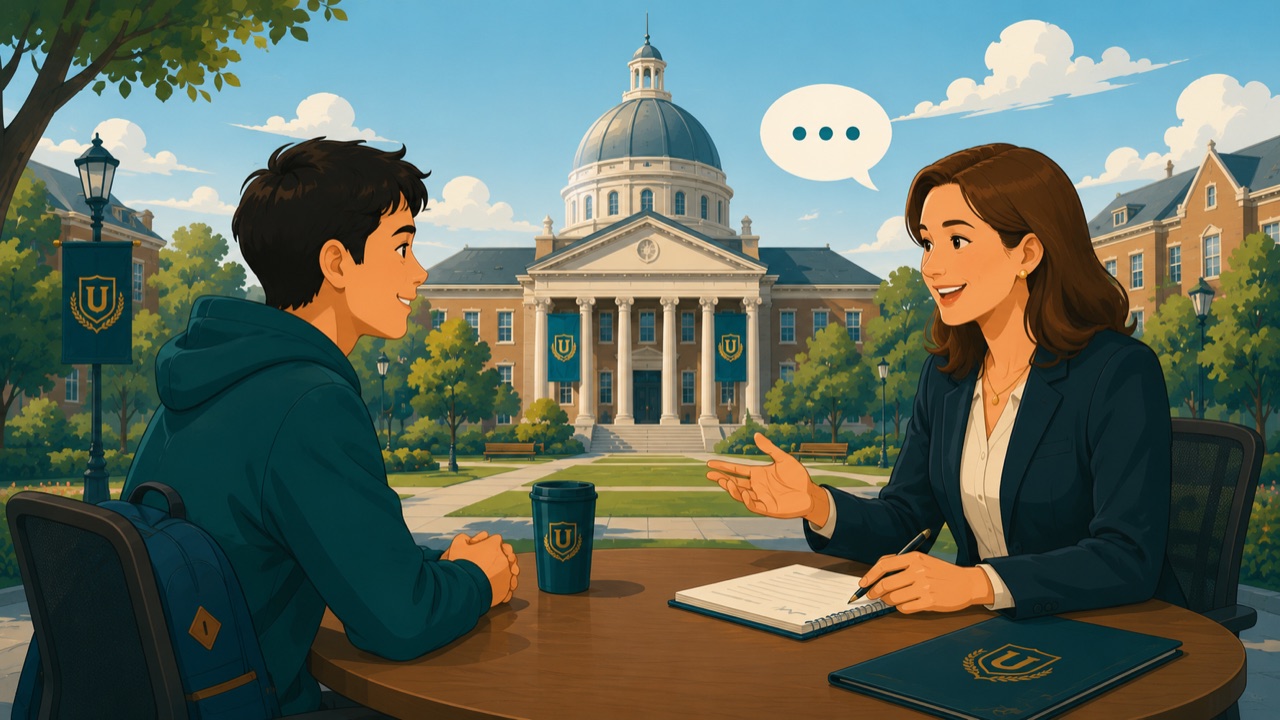
Students tend to panic about interviews out of proportion to what they are. They imagine a high-stakes interrogation that will make or break the application, prepare like it's a job interview at a bank, and arrive tense and over-rehearsed. The reality is calmer and worth understanding clearly, because once you know what the interview actually is and isn't, most of the anxiety drains away and you can do the few things that genuinely matter.
For the great majority of applicants, the interview is one of the lowest-weight parts of the application. It rarely makes a strong applicant and rarely breaks one. But “low-weight” isn't “no-weight,” and there are specific ways to help yourself and a few ways to quietly hurt yourself. Here's the honest picture.
What the interview actually is
Most college interviews are conducted by alumni volunteers, not admissions officers, and they happen after you've applied. The interviewer usually hasn't seen your full file, sometimes only your name. They write up a short report that gets added to your application as one more data point among many.
That structure tells you most of what you need to know. This is not a decision-maker grilling you on your qualifications. It's a conversation with a friendly graduate whose job is to get a human impression of you and pass it along. The weight it carries is real but modest, and at schools that have moved away from interviews entirely, it carries none. Understanding this is the first step to doing it well, because you stop treating it as a test and start treating it as what it is: a conversation.
What it's really evaluating
Since the interviewer mostly isn't assessing your credentials, what are they actually forming an impression of? Roughly three things:
- Are you a real, engaging person? The file shows a student. The interview shows a human. They're checking whether the person matches the application and whether you'd be good to have around.
- Is your interest genuine? Do you actually know and care about this school, or is it one of twenty names on a list? Genuine, specific interest comes through in conversation in a way it can't always on paper.
- Can you hold a thoughtful conversation? Not perform, not impress, but engage: listen, respond, show some curiosity and self-awareness.
Notice none of these is “prove you're smart enough” or “justify your achievements.” The transcript and essays already did that. The interview is a character and fit check, not a qualifications check.
How to actually prepare
Preparation helps, but not the kind students usually do. Memorizing polished answers makes you worse, because it makes you sound rehearsed and stops you from actually listening. Useful preparation looks like this:
- Know why this school, specifically. Be able to talk concretely about why you applied, in terms that show real knowledge, the same specificity that makes a good “Why us?” essay. This is the single highest-value thing to prepare.
- Be ready to talk about yourself like a person. Have a few things you genuinely care about that you can discuss with real warmth: an interest, a project, something you've been thinking about. Depth on a few real things beats a rehearsed tour of your resume.
- Prepare your own questions. A good interview is a two-way conversation, and thoughtful questions about the interviewer's experience signal genuine interest far more than a memorized speech. Ask things you actually want to know.
- Do a practice run, but not a scripted one. A mock conversation helps you get comfortable speaking about yourself out loud, which most students rarely do. The goal is fluency and ease, not a script.
The international student angle
A few things matter more when you're interviewing across a cultural gap:
- Norms differ, and that's worth knowing. In some cultures, speaking confidently about your own accomplishments feels arrogant, and students from those backgrounds can come across as withholding or overly modest to a US interviewer who expects you to talk openly about what you've done. You don't need to brag, but you do need to be willing to discuss your work directly.
- Conversational style varies. US interviews tend to be informal and warm, with some back-and-forth that can feel almost casual. If you're used to formal, deferential interactions with authority figures, the informality can be disorienting. Matching the conversational register helps.
- Language ease matters more than perfection. If English isn't your first language, the interviewer is not grading your grammar. They want to see that you can communicate comfortably. Speaking a little more slowly and naturally beats reaching for impressive vocabulary.
- If it's virtual, treat the logistics as part of the prep. Many international interviews happen online. Test your connection, find a quiet well-lit space, and look at the camera. Avoidable technical mess is the one part of a virtual interview that can genuinely distract from you.
The few ways an interview can actually hurt you
Since the interview rarely makes an application, the realistic downside is worth naming, because these are avoidable:
- Visible disinterest. An interviewer who comes away feeling you don't really care about the school, or couldn't say why you applied, can note that, and it lands as a fit problem.
- Arrogance or dismissiveness, especially treating an alumni interviewer as beneath your attention. Interviewers remember rudeness.
- Being so rehearsed you can't converse. A student running through memorized answers and unable to respond naturally reads as inauthentic, which is the opposite of the point.
- Treating it as unimportant to the point of not showing up prepared, or skipping an optional interview at a school you claim is a top choice, which can itself read as weak interest.
All of these are about character and interest, not ability, which is consistent with what the interview measures.
Keep it in proportion
The most useful mindset is the one the structure points to: this is a conversation with a friendly graduate of a school you're interested in, not a tribunal. Prepare enough to be fluent and specific, then relax enough to actually listen and respond. The students who interview best aren't the most polished. They're the ones who come across as genuine, engaged, and easy to talk to, which is mostly a matter of preparation freeing you up to be yourself rather than scripting you away from it.
The mistakes we fix most often
- Over-preparing into a script, so the student can't hold a natural conversation.
- Being unable to say why this school, the clearest signal of weak interest.
- Treating the alumni interviewer dismissively, which gets remembered.
- Reaching for impressive vocabulary instead of communicating comfortably.
- Excessive modesty across a cultural gap, reading as withholding to a US interviewer.
- Neglecting virtual logistics, letting avoidable tech problems distract from the conversation.
- Skipping optional interviews at schools the student claims to love.
Quick-start checklist
- Be able to talk specifically and sincerely about why this school
- Pick a few genuine interests you can discuss with warmth, not a resume recital
- Prepare real questions you actually want answered
- Do one unscripted practice conversation to get comfortable, not to memorize
- For virtual interviews, test the tech and set up a quiet, well-lit space
- Walk in treating it as a conversation, and let preparation make you relaxed, not robotic